Frau Elena
All the Light We Cannot SeeFrau Elena is the Protestant nun who cares for the children at Children’s House, but her influence comes less from strict supervision than from the small, sustaining freedoms she gives them. She sings, tells stories, and makes room for the children to gather around a radio. For Werner Pfennig, her care becomes a measure of home: even after he has left, he remembers her voice, her reassurance, and the ordinary warmth of the household as things the war cannot entirely erase.
Identity and Life at Children’s House
Frau Elena is from Alsace. She is described as more fond of children than of supervision, a defining contrast between her official responsibility and her forgiving manner. She sings French folk songs in a screechy falsetto, has a weakness for sherry, and sometimes falls asleep while standing. These details present a caregiver who is affectionate and fallible rather than imposing: the children’s household is held together by attention and familiarity, not by strict discipline.
On some nights, she lets the children stay up late to hear stories about her girlhood. Her accounts bring a far-off, wintry world into the children’s evenings: mountains, snow piled six feet deep on rooftops, town criers, creeks seeming to smoke in the cold, and vineyards dusted with frost. The stories are particular to her remembered childhood, yet their telling also makes the shared room at Children’s House a place where the children can imagine beyond their immediate surroundings.
Frau Elena’s care is expressed in practical gestures as well as in stories. She tousles Werner’s hair and encourages him to imagine a future larger than the limits other people may set for him. She recognizes that he might be dismissed as too young or as someone from nowhere, and counters that judgment with her belief in his ability. Her encouragement gives emotional weight to his ambitions: before Werner’s technical skill draws the attention of institutions and military authorities, someone in his home has already treated his hopes as worth taking seriously.
A Shared Household and Werner’s Sense of Home
The radio is one of the household’s recurring forms of companionship. Every evening Werner carries his set downstairs, and Frau Elena allows her wards to listen for an hour. The children gather in a semicircle among the furniture while they tune in to newscasts, concerts, operas, national choirs, and folk programs. The scene makes listening a collective routine rather than Werner’s private hobby. His interest in radio develops within a home where the device can bring many kinds of voices into the room and where its use is shared with the children who gather around it.
That domestic memory follows Werner after he leaves. In a moment of hardship, he recalls being young at Zollverein, towing his little sister in a wagon through the soot-stained alleys, and living among the children who slept head to toe in their dormitory. Within that recollection, Frau Elena moves among the beds at night, reassuring the children that she is beside them. The memory is not simply of a place he has left; it centers on the protection and closeness he associates with her presence.
Later, Werner’s longing for home gathers several details of Children’s House into one emotional landscape. He misses the sound of rain above his dormer, the energy of the orphans, and Frau Elena’s scratchy singing as she rocks a baby in the parlor. He also misses Jutta Pfennig most of all, remembering her loyalty and her sense of what is right. His homesickness therefore joins two kinds of attachment: his bond with his sister and his memory of Frau Elena as a caregiver who helped make the household feel secure.
Radio, Letters, and Continuing Connection
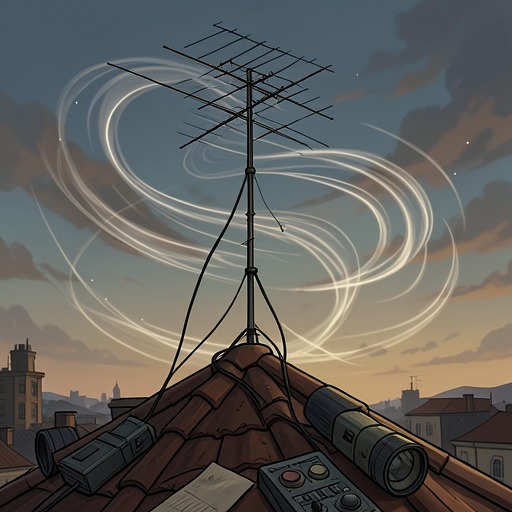
Frau Elena’s relationship with radio extends beyond the children’s evening listening. In a letter addressed to a professor, she wonders whether the station is still forwarding messages and notes that they have not heard the professor for at least two months. She describes the powerful transmitter in Brandenburg, which overwhelms much of the radio dial, and relays ideas about how an antenna, a rectifier, and a speaker can receive signals. The letter’s curiosity about reception gives radio an additional role in her life: it is not only a source of entertainment but also a possible means of keeping contact across distance and interruption.
Her letter preserves a voice distinct from the household scenes. She considers whether a metal filling might receive a broadcast and imagines songs carried in the teeth. The thought is presented as speculation rather than technical certainty, and it reveals an imaginative attentiveness to how a signal might travel when ordinary listening fails. The letter also places Frau Elena within the same world of disrupted communications that shapes Werner’s story, without suggesting that distance has ended her interest in the voices carried by the air.
The bond continues through Werner’s letters to Jutta Pfennig. He asks that Frau Elena be told he is eating well, while adding that nobody makes flour cakes like hers. The detail turns food into a measure of familiar care: even when he reports that he is managing, he compares his present circumstances with the comforts associated with home. In another letter, he sends love to both Jutta and Frau Elena. His messages show that he continues to think of Frau Elena not merely as someone from childhood but as a member of the intimate household to which he wants his words carried.
Wartime Separation and the Final Journey
The war changes the circumstances of Children’s House and eventually takes Frau Elena away from it. In January 1945, she and the last four girls still living there—Hannah and Susanne Gerlitz, Claudia Förster, and fifteen-year-old Jutta Pfennig—are transported from Essen to Berlin to work in a machine-parts factory. The move marks a sharp change from the remembered household of stories, radio, and care: the children and their caregiver are displaced together for wartime labor.
In Berlin, Frau Elena remains responsible for the girls amid uncertainty. When the water will not boil, she tells them that it will not be much longer. As the danger grows, she urges them to stay calm and indicates that she will go first, hoping the girls will be treated more gently afterward. Her response is protective, even though her voice is described as low and deflated rather than confident. The gesture brings the quality that defined her earlier care into a harsher setting: she tries to place herself between the girls and danger.
Frau Elena’s significance rests in the continuity between these ordinary and extreme acts of care. At Children’s House, she makes space for late-night stories, music, radio, and a child’s ambition; later, after displacement has taken the group to Berlin, she tries to steady the girls and shield them. Werner’s memories preserve her not as a distant symbol but through concrete habits and gestures: the singing, the night visits to the beds, the flour cakes, and the encouragement to dream beyond other people’s expectations. Those memories make her care part of the home he carries with him after leaving.